Breast Augmentation After Mounjaro: Restoring Lost Volume

Medically reviewed by Mr Debashis Ghosh, Consultant Breast & Cosmetic Surgeon, Harley Street Breast Centre. GMC: 4657664. FRCS, BAAPS, BAPRAS. Last reviewed: June 2026.
Quick Answer
Breast volume loss after Mounjaro, Ozempic or Wegovy is one of the most common concerns women raise in cosmetic consultations. Implant-based augmentation and autologous fat transfer are both viable solutions, but the right choice depends on your anatomy, the degree of volume loss and whether skin laxity is also present. Most surgeons advise waiting until your weight has been stable for at least 3-6 months before proceeding.
Key Takeaways
- GLP-1 receptor agonists (Mounjaro, Ozempic, Wegovy) cause breast volume loss through fat reduction – the glandular tissue isn’t affected.
- Both silicone implants and fat transfer can restore lost volume however, implants offer greater and more predictable uplift.
- If skin has become lax alongside volume loss, a breast lift (mastopexy) may be needed alongside augmentation.
- Weight should be stable for a minimum of 3-6 months before surgery to ensure predictable results.
- MHRA-approved implants from registered suppliers are used at Harley Street Breast Centre and all options comply with UK regulatory standards.
- A thorough consultation with a BAAPS-registered surgeon is essential before any decision is made.
On this page
- Why does Mounjaro cause breast volume loss?
- Is breast augmentation or fat transfer the right option for you?
- Implants versus fat transfer: a comparison
- What implant options are available?
- When should you wait before having augmentation after GLP-1 drugs?
- What does breast augmentation surgery involve?
- Recovery after breast augmentation
- Risks and realistic expectations
- Frequently asked questions
- Sources
Mounjaro (tirzepatide) and similar GLP-1 receptor agonists have changed how patients and surgeons think about body composition. Across UK clinics, the number of women seeking cosmetic breast surgery after significant weight loss on these medications has risen sharply over the past 2 years. The concern is consistent: they feel well, they look well from a health perspective, but their breasts no longer feel like their own. The volume has gone and sometimes the skin has loosened too.
This page explains what happens to the breast during GLP-1-driven weight loss, the surgical options available to restore volume, how to decide between implants and fat transfer and the realistic timing you need to plan around. All information here reflects the approach taken by Mr Debashis Ghosh, Consultant Breast and Cosmetic Surgeon at Harley Street Breast Centre, 146 Harley Street, London.
1. Why does Mounjaro cause breast volume loss?
The short answer is that breasts are largely composed of adipose (fat) tissue. When you lose weight on any programme – dietary, surgical or pharmacological – fat is lost from across the body, including the breasts. GLP-1 receptor agonists do not selectively preserve fat in certain areas – they reduce caloric intake and over time lead to widespread fat loss.
Mounjaro (tirzepatide) acts on both GLP-1 and GIP receptors, making it one of the more potent medications in this class. Clinical trials reported average weight losses of 15-22% of body weight and some patients on the highest doses lose considerably more. For women who carried a significant proportion of their breast volume as fat tissue, this loss can be dramatic.
The glandular tissue – the actual breast parenchyma – is not broken down by weight loss. Ligaments and skin, however, may stretch and fail to retract, particularly if weight loss is rapid. This is why some women notice not just volume loss but also ptosis (drooping) or a deflated appearance, even when the underlying structure remains intact.
What you are left with is a breast that may have good glandular structure but insufficient fat to give it shape, projection and fullness. For many women, this feels like a disproportionate loss – they did not intend to lose breast volume when they began medication and the change affects how they feel in clothes and out of them.
2. Is breast augmentation or fat transfer the right option for you?
Before any surgical decision is made, it is important to understand what you have lost and what you want to restore. Volume loss after GLP-1 medications falls into broadly three categories:
- Mild volume loss with no skin laxity – a good candidate for fat transfer, provided there is a sufficient donor site.
- Moderate to significant volume loss with minimal or no ptosis – a good candidate for implant-based augmentation.
- Volume loss with ptosis (drooping) – may require augmentation combined with a mastopexy (breast lift) to achieve both fullness and position.
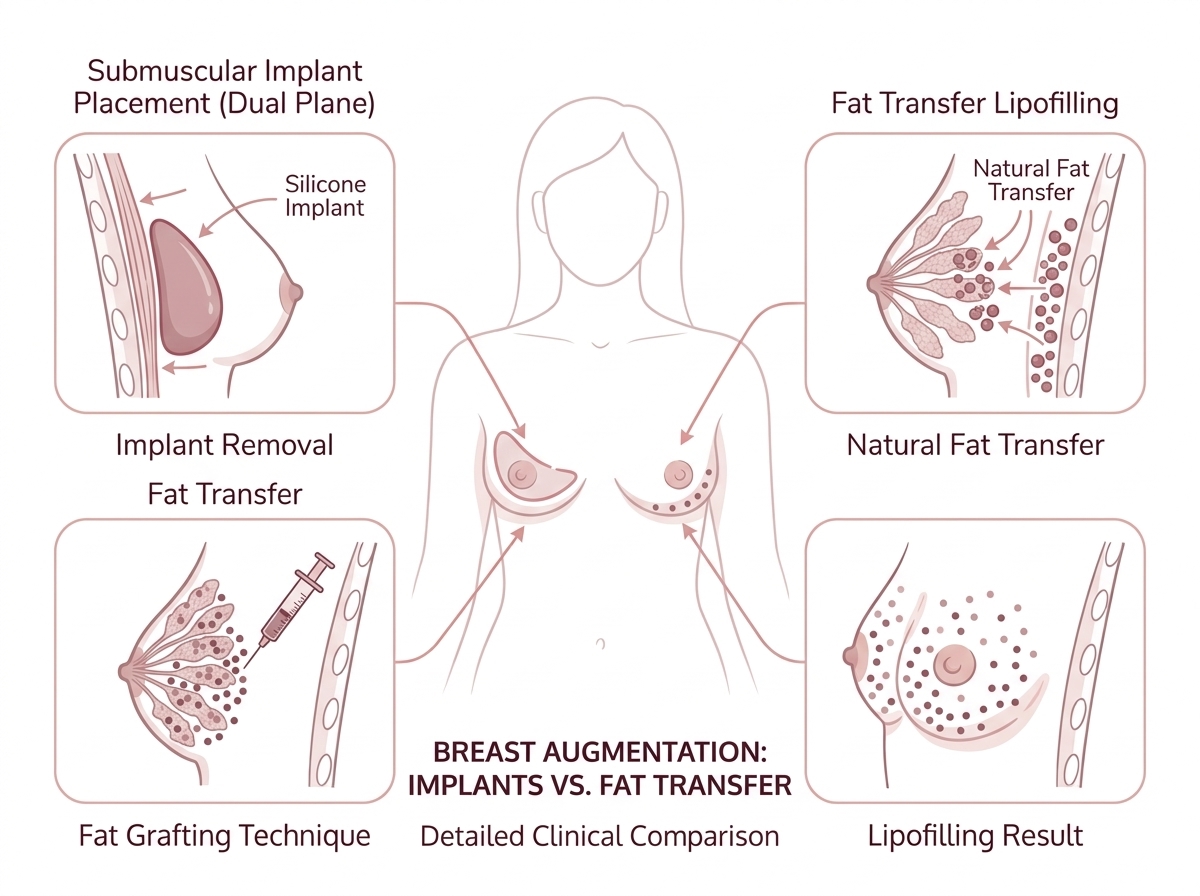
Fat transfer is appealing because it uses your own tissue, produces very natural results and leaves minimal scarring however, it has limits. The volume achievable in a single session is typically 100-200cc per breast at best and around 30-40% of transferred fat will not survive long term. For women who have lost a cup size or more, implants tend to deliver a more reliable and lasting result.
Implants can restore virtually any volume and give predictable, lasting projection. They are the right choice for women who have lost a substantial amount of breast tissue and want a defined, full result. The trade-off is a small scar (typically in the inframammary fold or around the areola), a recovery period of 4-6 weeks and a device that may require monitoring over time.
3. Implants versus fat transfer: a comparison
The table below compares the two main approaches. Use it as a starting point – your surgeon will refine the recommendation based on your individual anatomy.
| Factor | Silicone Implants | Fat Transfer (Lipofilling) |
|---|---|---|
| Best for | Moderate to large volume loss – women wanting defined shape and projection | Mild volume loss – women wanting a subtle, natural result |
| What it does | Inserts a medical-grade silicone gel implant to add volume and projection | Removes fat via liposuction from abdomen, thighs or flanks and injects it into breast tissue |
| Volume achievable | Highly customisable – virtually any volume increase | Typically 100-200cc per session – 30-40% reabsorption rate |
| Longevity | Device lasts 10-20+ years – monitoring recommended every few years | Surviving fat is permanent – session may need repeating for more volume |
| Recovery | 4-6 weeks to full activity – sports bra for 6 weeks | 2-3 weeks – compression garments on donor site for 4-6 weeks |
| Scarring | Small incision scar (inframammary fold or periareolar) – usually well hidden | Small liposuction puncture marks – virtually invisible at 12 months |
| Ideal candidate | Lost a cup size or more – good skin elasticity or mild ptosis | Lost modest volume – has adequate fat donor sites and prefers natural feel |
4. What implant options are available?
At Harley Street Breast Centre, implants are sourced exclusively from MHRA-registered suppliers and comply fully with UK regulatory requirements for breast implant safety. The MHRA maintains a public register of approved breast implant devices and all implants used here are listed on that register.
Implant profile
Profile determines how far the implant projects from the chest wall relative to its width. Low, moderate and high profile options exist. After weight loss, moderate or high profile implants often work well because they restore projection that has been lost along with the fat.
Implant shape
Round implants give fullness in the upper pole and are the most commonly placed. Anatomical (teardrop) implants provide a more sloped shape, with greater volume in the lower pole. Your choice will depend on the look you want and on how much upper pole volume you currently have.
Implant surface
Both smooth and textured implants are available. The MHRA and BAAPS have published guidance on textured implants and their relationship to a rare condition called BIA-ALCL (breast implant-associated anaplastic large cell lymphoma). Mr Ghosh will discuss this risk in your consultation and recommend the appropriate option based on current evidence and your individual anatomy.
Implant size
Size is measured in cubic centimetres (cc) and is chosen by assessing chest wall dimensions, existing breast tissue and your aesthetic goals. Sizing is a collaborative process and typically involves 3D imaging or physical sizers during your consultation. Most women seeking to restore lost volume after Mounjaro choose implants in the 200-375cc range, though this varies considerably.
Implant placement
Submuscular placement (behind the pectoralis major muscle) gives good tissue coverage and tends to produce natural movement. It is particularly suited to women with limited breast tissue after weight loss. Subglandular placement (above the muscle) gives a rounder, fuller appearance in the upper pole but requires adequate tissue thickness to prevent visible implant edges. Dual plane techniques combine elements of both. Mr Ghosh will discuss which plane is most appropriate for your anatomy.
5. When should you wait before having augmentation after GLP-1 drugs?
Timing is one of the most important practical decisions you will make. Operating on a breast that is still losing volume produces an unpredictable result – the size you are augmenting to may not be where you end up.
The consensus among experienced surgeons is that weight should be stable for a minimum of 3-6 months before surgery. For most patients this means:
- You are at or close to your goal weight and not planning to lose further.
- Your weight has not fluctuated by more than 2-3 kilograms over the preceding 3 months.
- If you intend to continue GLP-1 medication, you have reached a maintenance dose.
- You have had at least 1 follow-up with your prescribing clinician confirming weight stability.
Some patients pause GLP-1 medication before surgery. If you are considering this, discuss it with your prescribing clinician first – stopping abruptly can lead to weight regain, which would again affect your result. There is no single right answer – the important thing is that the body Mr Ghosh operates on is as close as possible to the body you will have long term.
If you are still actively losing weight, a consultation now is still worthwhile. Mr Ghosh can assess your current anatomy, set a target timeline and begin planning so that surgery can proceed as soon as you reach stability.
The women I see who have been on Mounjaro or a similar drug have done something remarkable for their health. But the breast changes are real and often distressing. My job is not to talk anyone into surgery – it is to give an honest assessment of what is happening anatomically, what the options are and what a realistic result looks like. For some patients a fat transfer is exactly right and for others the degree of volume loss means implants are the only way to achieve what they are after. I will not know which until I have examined them properly and understood what matters most to them.
Mr Debashis Ghosh, Consultant Breast and Cosmetic Surgeon
6. What does breast augmentation surgery involve?
Breast augmentation is performed under general anaesthetic as a day procedure. The operation typically takes 60-90 minutes.
Mr Ghosh makes a small incision, most commonly in the inframammary fold (the natural crease beneath the breast), where the scar will be least visible. A pocket is created either beneath the breast tissue or beneath the pectoral muscle, the implant is placed and positioned and the incision is closed with dissolvable sutures. Surgical drains are not routinely used.
You will wake up in a surgical bra, which you will wear continuously for the first 6 weeks. Most patients go home the same day, though you will need someone to drive you and stay with you overnight.
If fat transfer is being performed, the procedure begins with liposuction to harvest fat from your chosen donor site. This fat is processed and refined before being injected in small aliquots into the breast tissue. The procedure takes longer than implant surgery alone – typically 2-3 hours.
Book a consultation with Mr Ghosh
If you have lost breast volume on Mounjaro, Ozempic or Wegovy and want to understand your options, book a consultation with Mr Ghosh. You will get an honest assessment of your anatomy and an all-inclusive quote.
7. Recovery after breast augmentation
Recovery timelines for breast augmentation are well established and most patients find them manageable with preparation.
- Days 1-3: Rest is essential and pain is typically moderate and well controlled with prescribed analgesia. Swelling and bruising are normal and expected.
- Days 4-7: Many patients feel significantly more comfortable. You can move around the house and take short walks, but should avoid raising your arms above shoulder height.
- Weeks 2-4: Light desk-based work can usually resume by 10-14 days. You will still be wearing the surgical bra. No lifting or strenuous exercise.
- Weeks 4-6: Most patients are cleared for driving at 4 weeks and gentle exercise at 6 weeks. Upper body exercise and swimming return at 6-8 weeks.
- 3-6 months: Implants settle into their final position. Scars continue to mature and fade for 12-18 months.
Fat transfer recovery differs slightly. The donor site (typically abdomen or thighs) will be bruised and swollen and you will need to wear a compression garment there for 4-6 weeks. Breast swelling resolves over 2-3 months as the surviving fat establishes its blood supply.
You will attend follow-up appointments at 1 week, 6 weeks and 3 months. Mr Ghosh and his team are available throughout your recovery should you have concerns.
8. Risks and realistic expectations
Breast augmentation is one of the most commonly performed cosmetic operations in the UK and has a well-documented safety profile. As with any surgery under general anaesthetic, risks exist and patients must understand them before consenting to proceed.
General surgical risks
- Bleeding (haematoma): occurs in approximately 1-3% of cases and may require a return to theatre.
- Infection: uncommon (around 1-2%) but requires antibiotic treatment and rarely the implant may need to be removed temporarily.
- Adverse reaction to anaesthesia: rare – assessed preoperatively during your anaesthetic review.
- Wound healing problems: more common in smokers and those with diabetes.
Implant-specific risks
- Capsular contracture: scar tissue around the implant can harden and distort the breast. Rates vary by technique and implant type but affect around 5-10% of patients over the long term.
- Implant rupture: modern cohesive gel implants are durable. Rupture rates are low but monitoring with periodic MRI or ultrasound is recommended.
- BIA-ALCL: a rare type of lymphoma associated primarily with textured implants. Current UK prevalence is estimated at fewer than 1 in 24,000 textured implant procedures. Mr Ghosh will discuss this fully during your consultation.
- Implant visibility or palpability: more likely in very slim patients with minimal tissue coverage.
- Asymmetry: minor asymmetries are common postoperatively and usually resolve as swelling settles.
The MHRA maintains a breast implant registry and publishes safety guidance for patients and clinicians. You can access this at gov.uk/guidance/breast-implants. Harley Street Breast Centre complies fully with MHRA requirements, including registration of all implant procedures.
All implants carry a Product Identification Card that must be given to you at the time of your procedure. Keep this in a safe place – it contains details of the implant type, batch number and manufacturer.
Realistic expectations
Breast augmentation after Mounjaro weight loss can produce excellent results, but you should have a clear-eyed understanding of what surgery can and cannot do:
- Volume is reliably restored and projection, shape and fill in the upper pole will be improved.
- Significant skin laxity may not be fully corrected by augmentation alone. If you have ptosis, a mastopexy may be needed as a staged or combined procedure.
- Scars are permanent – they fade considerably over 12-18 months but do not disappear.
- Implants are not lifetime devices – revision surgery at some point in the future is a realistic expectation.
- If you resume GLP-1 medication and lose further weight, implant results may be affected.
Frequently asked questions
Will my breast size keep changing if I stay on Mounjaro?
Quite possibly, yes. If you are still losing weight, your breast volume may continue to decrease. This is one of the main reasons surgeons advise waiting until your weight has been stable for at least 3 months before considering surgery. Operating on a breast that has not yet settled in size risks an unpredictable or unsatisfactory outcome.
Can I have a breast lift at the same time as augmentation?
Yes. A combined augmentation-mastopexy (augmentation with lift) is possible and commonly performed where there is both significant volume loss and skin laxity however, combining procedures increases operating time and recovery. Some surgeons prefer to stage the two operations, particularly where the degree of ptosis is significant. Mr Ghosh will advise which approach is most appropriate for your anatomy at your consultation.
How much does breast augmentation after Mounjaro cost?
Pricing at Harley Street Breast Centre is all-inclusive: surgeon fee, anaesthesia, hospital facility, post-operative garments and follow-up appointments are all covered in a single quote. The exact figure depends on the complexity of your procedure. You will receive a full written quote at your consultation. Payment plans are available.
Will silicone implants interfere with mammograms?
Implants can make mammogram interpretation more challenging, though they do not prevent it. Radiographers are trained to work with implants and use additional views (the Eklund displacement technique) to visualise breast tissue around the device. Always inform your radiographer that you have implants when attending screening.
What happens if I lose more weight after surgery?
Further weight loss after augmentation can affect the result. The implant itself does not change, but the surrounding tissue coverage will thin if fat continues to be lost. This is another reason to ensure weight stability before surgery. If you intend to continue GLP-1 medication, discuss your long-term weight goals openly with Mr Ghosh so implant selection can account for this.
Is fat transfer a safer option than implants?
Neither procedure is inherently safer than the other – they carry different risk profiles. Fat transfer avoids the risks associated with a permanent device (such as capsular contracture or implant rupture) but carries its own risks, including fat necrosis (death of transferred fat cells creating hard lumps) and unpredictable reabsorption. The right choice depends on your goals, anatomy and the degree of volume loss, not on a blanket assessment of which is safer.
When can I go back to the gym after breast augmentation?
Gentle lower body exercise (walking, cycling on a stationary bike) is generally fine from 4 weeks. Upper body exercise and anything that raises intra-thoracic pressure should wait until 6-8 weeks, when Mr Ghosh has confirmed the implant is settled. High-impact sports such as running and swimming are typically cleared at 8 weeks.
Does augmentation affect breastfeeding?
Most women with implants can breastfeed, though this depends partly on the incision site and implant placement. Periareolar incisions carry a slightly higher risk of interfering with milk ducts. If you are planning a future pregnancy and intend to breastfeed, raise this at your consultation so it can inform the surgical plan.
How long do results last after breast augmentation?
The implant itself typically lasts 15-20 years or more, though some require replacement sooner due to rupture, capsular contracture or changes in preference. The result may also change with further weight fluctuation, pregnancy or natural ageing. Most patients do not need surgery within the first decade, but revision at some point in their lifetime is a realistic expectation.
Do I have to stop Mounjaro before surgery?
There is no universal guideline, but most anaesthetists recommend pausing GLP-1 medications for 1 week before surgery because these drugs slow gastric emptying, increasing aspiration risk. Some anaesthetists request a longer pause. You should discuss this with both your prescribing clinician and your anaesthetist in the pre-operative period. Do not stop or adjust medication without medical advice.
Can Ozempic or Wegovy cause the same breast changes as Mounjaro?
Yes. Ozempic (semaglutide) and Wegovy (also semaglutide, at a higher dose) are GLP-1 receptor agonists that work through a similar mechanism. They induce caloric restriction and weight loss, with the same potential for breast volume loss as Mounjaro. The degree of loss depends on the total weight change and the individual’s breast composition.
Sources
- British Association of Aesthetic Plastic Surgeons (BAAPS)
- MHRA Breast Implant Safety Guidance (UK)
- British Association of Plastic, Reconstructive and Aesthetic Surgeons (BAPRAS)
Medical disclaimer
This article is for informational purposes only and does not constitute medical advice. Individual surgical results vary. The risks and benefits of any procedure should be discussed in full at a private consultation with a qualified surgeon. ASA/CAP guidance applies to all information relating to cosmetic surgery. Surgery is not suitable for everyone.
About Mr Debashis Ghosh
Mr Debashis Ghosh is a Consultant Breast and Cosmetic Surgeon based at Harley Street Breast Centre, 146 Harley Street, London W1G 7LD. He holds fellowship of the Royal College of Surgeons (FRCS) and is a member of both BAAPS and BAPRAS. Mr Ghosh specialises in cosmetic breast surgery, breast oncoplastic procedures and breast reconstruction, with a particular interest in helping patients achieve natural, proportionate results. He can be reached on +44 (0) 207 034 6534.
If breast augmentation after Mounjaro is affecting how you feel about your body, the next step is an assessment with a BAAPS and BAPRAS registered surgeon. Mr Debashis Ghosh, Consultant Breast and Cosmetic Surgeon at the Harley Street Breast Centre, 146 Harley Street, London, will examine you, grade the changes and set out which options are realistic for your anatomy.
Ready to restore your confidence?
Breast volume loss after GLP-1 medication is one of the most treatable cosmetic concerns we see at Harley Street Breast Centre. Whether you are considering implants, fat transfer or a combined lift and augmentation, Mr Ghosh will give you a frank assessment and a clear plan.
Phone: +44 (0) 207 034 6534
Wondering what this means for you?
Start with a free telephone consultation from home, or meet Mr Ghosh in person on Harley Street. Ask anything, decide nothing until you are ready.
Book a Consultation