Loose Skin on Breasts After Weight Loss Injections: What Surgery Can and Cannot Fix

Medically reviewed by Mr Debashis Ghosh, Consultant Breast & Cosmetic Surgeon, Harley Street Breast Centre. GMC: 4657664. FRCS, BAAPS, BAPRAS. Last reviewed: June 2026.
Quick answer
Loose skin on the breasts following GLP-1 weight loss injections (Mounjaro, Ozempic, Wegovy) results from permanent elasticity loss that does not reverse once weight has been lost.
Surgery can remove the excess skin envelope and reshape the breast but it can’t restore skin quality, reverse thinning of the dermis or guarantee symmetry if weight continues to fluctuate. An honest, in-person assessment is essential before any decision is made.
Key takeaways
- GLP-1 drugs (Mounjaro, Ozempic, Wegovy) cause rapid fat loss that frequently outpaces skin contraction, leaving excess, loose skin on the breasts.
- Loose skin, sagging (ptosis) and volume loss are 3 distinct problems that often coexist and require different surgical approaches.
- Surgery (mastopexy, augmentation or a combination) can remove excess skin and reshape the breast, with results lasting many years in weight-stable patients.
- Surgery cannot restore skin quality, repair very thin or damaged dermis or deliver predictable results in patients who are still actively losing weight.
- Weight stability for at least 6 months is the minimum threshold and Mr Ghosh generally recommends 12 months before surgery.
- All surgical options carry real risks including scarring, asymmetry, changes to nipple sensation and the possibility of revision surgery.
On this page
- Why do weight loss injections cause loose skin on the breasts?
- What is the difference between loose skin, sagging and volume loss?
- Does skin tighten on its own after GLP-1 weight loss?
- What can surgery realistically achieve for loose breast skin?
- What surgery cannot fix
- Choosing the right surgical approach for your situation
- When is the right time to consider surgery?
- Risks and realistic expectations
- Frequently asked questions
- Sources
Millions of people across the UK are now using GLP-1 receptor agonists such as Mounjaro (tirzepatide), Ozempic (semaglutide) and Wegovy to achieve significant weight loss.
For many, the results have been life-changing however, weight loss of 15-30% of body mass in a matter of months brings its own set of physical consequences and the breasts are among the most affected areas of the body.
Patients frequently describe a similar experience – the weight is gone but their breasts now feel deflated, the skin looks crinkled or folded and their bra no longer fits in the way it once did and some women feel self-conscious in ways they did not anticipate.
This article addresses those questions directly and it explains the biology behind loose breast skin after GLP-1 injections, what surgery can realistically achieve and critically, what it cannot fix.
1. Why do weight loss injections cause loose skin on the breasts?
GLP-1 receptor agonists work by suppressing appetite, slowing gastric emptying and improving insulin sensitivity. The result is a caloric deficit sustained over months, leading to significant fat loss across the body. The breasts, which are composed largely of adipose (fatty) tissue supported by Cooper’s ligaments and the overlying skin envelope, are directly affected.
Skin has 2 properties that determine how well it adapts to changes in body volume – elasticity and collagen density.
In younger patients or those with naturally resilient skin, a moderate degree of fat loss may be accommodated without significant visible laxity however, in patients over 35 years old, those who have previously been pregnant or in those who lose weight rapidly, these properties are often insufficient.
The skin stretches to accommodate fat so when fat is removed rapidly, the skin does not automatically contract to match the new, smaller volume beneath it and instead it remains as an excess envelope.
Collagen fibres that have been stretched over years do not simply spring back. The degree of loose skin is influenced by the amount of weight lost, the speed at which it was lost, the patient’s age, their genetic skin type and their smoking history.
GLP-1-induced weight loss tends to be faster than the rate achieved through diet and exercise alone, which partly explains why loose skin is a common complaint among patients on these medications. A person who loses 25 kilograms over 14 months has given their skin very little time to adapt.
The breasts themselves sit on the chest wall with no underlying muscle support directly behind the breast tissue. Once the fat that gives the breast its volume reduces, the skin envelope and the stretched Cooper’s ligaments have nothing to hold their shape against. Sagging and folding follow.
2. What is the difference between loose skin, sagging and volume loss?
Patients frequently use these terms interchangeably, but they describe 3 anatomically distinct problems that require different surgical solutions. Understanding the distinction matters because treating the wrong problem or only one of several coexisting problems produces a result that fails to meet expectations.
| Condition | Cause | Appearance | Surgical solution |
|---|---|---|---|
| Loose skin | Elasticity loss following rapid fat reduction | Excess, crinkled or folded skin – breast may feel deflated and soft | Mastopexy (breast lift) with skin excision |
| Sagging / ptosis | Descent of breast tissue and nipple-areola complex below the inframammary fold | Nipple points downward – breast lacks upper pole fullness regardless of size | Mastopexy – degree of lift determined by grade of ptosis |
| Volume loss / deflation | Loss of glandular and adipose tissue during weight loss | Flat upper breast; bra fits looser; skin may look adequate | Breast augmentation (implants or fat transfer) – often combined with lift |
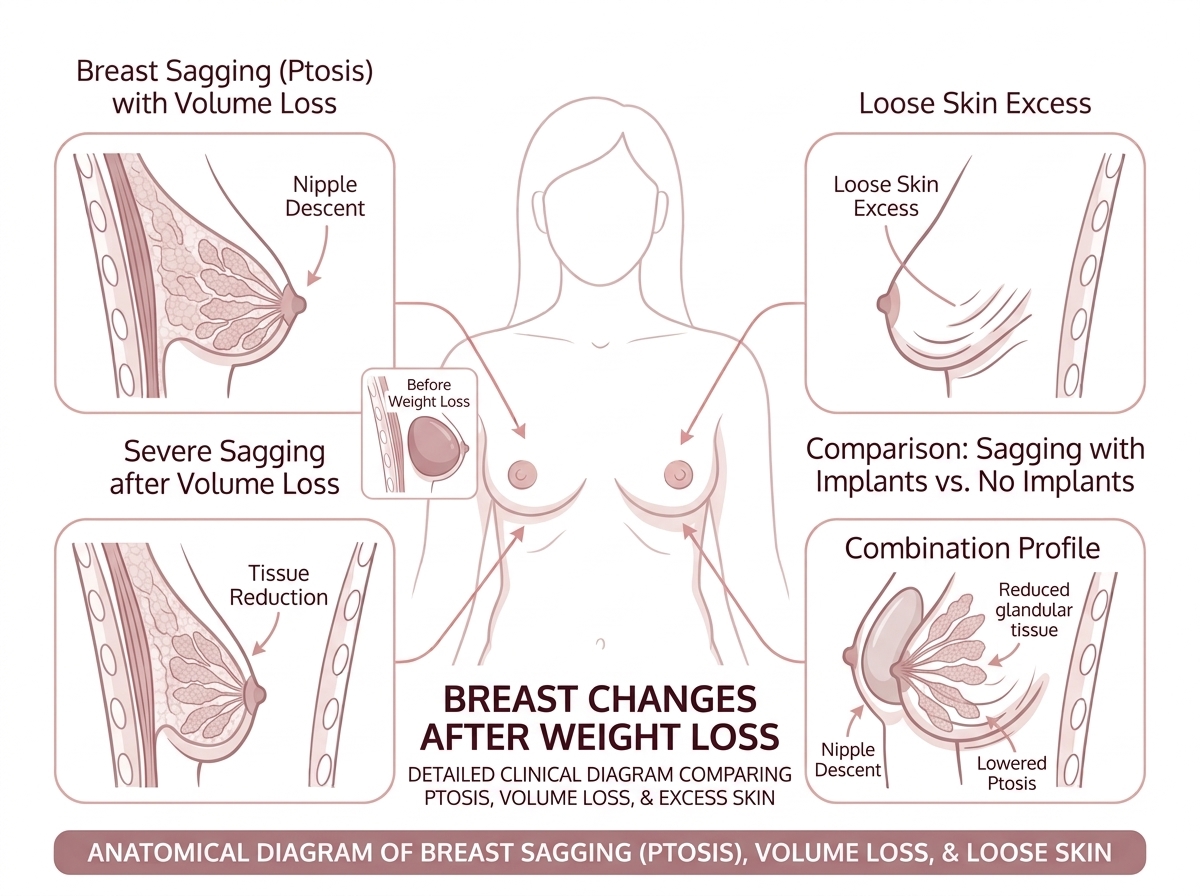
In practice, most women who present after GLP-1 weight loss have a combination of all 3: their breasts have lost volume, the nipple and breast tissue have descended and there is excess skin that does not sit neatly on the new, smaller breast mound. The first step of any surgical assessment is to separate these components and plan accordingly.
Ptosis is graded by the position of the nipple-areola complex relative to the inframammary fold (the natural crease beneath the breast):
Grade 1 (mild) ptosis means the nipple sits at or just below the fold.
Grade 2 (moderate) means it sits below the fold.
Grade 3 (severe) means the nipple points downwards and sits at the lowest part of the breast. Each grade generally requires a progressively more involved surgical correction.
3. Does skin tighten on its own after GLP-1 weight loss?
To a limited extent, yes, but not predictably and rarely sufficiently. Our skin has some capacity to contract following volume reduction, particularly in younger patients with good baseline elasticity.
This process takes time – most of what will happen spontaneously occurs within 6-12 months of weight stabilisation.
The factors that reliably predict poor spontaneous contraction include age over 40, a history of significant sun exposure, smoking, prior major weight fluctuations, large amounts of weight lost and a family history of poor skin elasticity. For many patients presenting after GLP-1 drug use, several of these factors are present simultaneously.
Non-surgical technologies such as radiofrequency skin tightening, ultrasound-based treatments and laser procedures are marketed as alternatives – these can improve skin texture and stimulate a modest degree of dermal contraction in patients with mild laxity.
They cannot address significant excess skin after major weight loss. If there is enough loose skin to fold or gather in the hand, non-surgical options will not resolve it.
Waiting until weight has been stable for at least 6 months is essential before any judgement is made about how much skin laxity remains. Operating before the skin has had an opportunity to settle leads to suboptimal results and increases the likelihood of revision.
4. What can surgery realistically achieve for loose breast skin?
Surgery addresses what biology cannot. When weight is stable and the skin has reached its natural post-weight-loss equilibrium, the right surgical procedure can produce a significant and lasting improvement. The key is matching the procedure to what has actually happened to the breast.
Mastopexy (breast lift)
A mastopexy removes excess skin from the breast, reshapes the remaining breast tissue into a higher, rounder position and repositions the nipple-areola complex – this procedure addresses loose skin and ptosis directly however, it does not add volume.
The extent of the lift and the pattern of incisions used depends on the degree of ptosis and the amount of excess skin. A periareolar lift (scar around the areola only) suits mild cases.
A vertical lift (scar around the areola and a vertical line to the fold) is used for moderate cases. An inverted-T or Wise-pattern lift adds a horizontal scar along the inframammary fold and is used where there is significant skin excess, often following major weight loss.
Results are durable in patients who maintain a stable weight – the breast will continue to age naturally and significant future weight fluctuations can compromise the result.
Patients should understand that a mastopexy does not stop the ageing process – it resets the position of the breast and removes the excess that cannot resolve on its own.
Breast augmentation with or without lift
Where the primary concern is volume loss, a breast augmentation using implants or fat transfer can restore fullness. Many patients after GLP-1 weight loss need both a lift and augmentation because they have lost volume and their breast has descended simultaneously.
A combined mastopexy-augmentation is more complex than either procedure alone. The 2 procedures work in opposing mechanical directions: an implant adds volume and tension to the lower pole, while a lift tightens the skin envelope.
Combining them requires careful surgical judgement to avoid complications and the risk of revision is slightly higher than for either procedure performed in isolation.
Some surgeons prefer to stage the procedures, performing the lift first and the augmentation at a later date once the tissues have settled.
The decision between implants and fat transfer depends on the amount of volume required and whether the patient has sufficient donor fat for transfer. Fat transfer provides a more natural result and avoids the long-term commitments associated with implants, but it cannot achieve the same degree of volume increase in a single session.
The patients I see after Mounjaro or Ozempic treatment are often dealing with 3 overlapping problems at once – they have less breast tissue, the skin is looser than expected and the breast has dropped. Treating all 3 requires a precise assessment. I can reshape the breast effectively when weight is stable but I am always honest about what the scar pattern will look like, how skin quality affects the result and what the realistic outcome is for their anatomy specifically. There is no procedure that gives you the breast of a 25-year-old if your skin has been through significant stretching.
Mr Debashis Ghosh, Consultant Breast and Cosmetic Surgeon
5. What surgery cannot fix
This section is as important as the one above. Surgery is a powerful tool, but it works within the limits of human biology so understanding these limits enables you to make more informed decisions about what is best for you.
Poor skin quality and very thin skin
Major weight loss, particularly rapid loss driven by GLP-1 drugs, does not just create an excess skin envelope – it can change the quality of the skin itself.
The dermis thins and collagen structures that have been chronically stretched lose their integrity. Fibroblasts (the cells responsible for collagen production) are less active in skin that has been significantly stretched over a long period.
Thin, poor-quality skin does not hold sutures as well as healthy skin. It is more prone to wound healing problems, including delayed healing, suture spitting and scarring that widens over time. It is less likely to produce a clean, well-healed scar and more likely to result in scars that are noticeable.
Surgery cannot restore dermal thickness or collagen density – it can remove the excess, but the quality of what remains determines how well the result heals and how long it lasts.
Continued weight loss or planned future GLP-1 use
Surgery performed while a patient is still losing weight or while they plan to return to GLP-1 treatment in the future is likely to produce an unsatisfactory outcome.
A breast lift performed on a breast that continues to change in size and shape after surgery will not maintain its result as the skin that was carefully tightened may become loose again.
The volume that was placed with an implant may become disproportionate as surrounding tissue continues to reduce.
The recommendation is clear: be at a stable weight you intend to maintain and have no plans to resume GLP-1 medication for further weight reduction, before considering surgery.
Unrealistic expectations about scars
Every mastopexy leaves permanent scars and the scar pattern depends on the amount of skin removed.
For patients with significant post-weight-loss skin excess, the inverted-T or Wise-pattern scar is often unavoidable. This leaves a scar around the areola, a vertical scar to the fold and a horizontal scar along the inframammary crease. These scars are permanent, although they typically fade and flatten over 12-24 months.
No surgical technique eliminates scarring so it is important to be wary of anyone that tells you otherwise.
Surgical technique, good wound care and non-smoking status all reduce the visibility of scars, but they do not make them disappear completely.
Non-surgical alternatives that promise skin tightening
There are many devices and treatments available that are marketed as non-surgical alternatives to a breast lift.
While some technologies have a legitimate evidence base for mild skin tightening in appropriate patients, none can address the degree of excess skin created by major GLP-1-induced weight loss.
If you have been promised results equivalent to surgery through a machine-based treatment, seek a second opinion from a consultant surgeon with no commercial interest in the device being promoted.
Asymmetry
Few breasts are perfectly symmetrical before surgery and surgery cannot guarantee perfect symmetry after. Where one breast has lost more volume than the other or where the degree of sagging differs between sides, achieving balance is more challenging. Surgeons aim for close symmetry, but patients must understand that minor differences between the two sides are common and normal after any breast procedure.
Book a consultation with Mr Ghosh
Understanding what surgery can and cannot do for your specific situation requires an assessment in person. Mr Ghosh will examine your anatomy and give you honest, realistic information about the options available to you.
6. Choosing the right surgical approach for your situation
There is no single correct procedure for patients with loose breast skin after GLP-1 weight loss. The right approach depends on the degree of skin excess, the amount of volume lost, the grade of ptosis, the quality of the skin and whether the patient wants to restore volume as well as reshape the breast.
A thorough consultation should include a physical examination that assesses all 3 components: skin laxity, ptosis grade and volume.
Photographs will usually be taken and the surgeon should explain the proposed procedure or combination of procedures, the scar pattern involved, the recovery timeline, the realistic result and the risks specific to the patient’s anatomy.
Be cautious of consultations that offer a definitive surgical plan without a physical examination. Photographs are useful, but they cannot replace an in-person assessment of skin quality, tissue mobility and the way the breast behaves in different positions.
Mastopexy alone
Suitable for patients who are broadly happy with their breast size but want to address sagging and excess skin. The breast is reshaped and repositioned without adding volume. This works best in patients with good baseline skin quality and realistic expectations about scarring.
Augmentation alone
Suitable for patients whose primary complaint is volume loss and who have only mild ptosis. Adding volume can fill the skin envelope partially. If ptosis is more than mild, an augmentation alone typically worsens the droop by adding weight to a breast that has already descended.
Mastopexy-augmentation (combined)
The most commonly required procedure for patients after significant GLP-1 weight loss – it addresses volume loss and skin excess simultaneously.
The surgical planning is more complex and the recovery is longer, but for patients who need both corrections it avoids two separate operations.
Staged approach
Some surgeons prefer to perform the lift first, allow 6-12 months for the tissues to settle and then add volume if required.
This approach reduces the risk of complications that can occur when the 2 procedures are combined, but it requires 2 separate operations and recovery periods.
7. When is the right time to consider surgery?
Timing is one of the most important factors in achieving a good surgical outcome after GLP-1 weight loss.
The minimum requirement is weight stability for at least 6 months but sometimes waiting until 12 months of skin stability is the best option.
This is not an arbitrary delay – it reflects the reality that skin contraction continues for many months after weight loss stops and that operating on a body that is still changing produces results that may not last.
Patients should also have discontinued any intention to continue GLP-1 treatment for further weight loss. Surgery on a patient who plans to lose another 10-15 kilograms is unlikely to produce a durable result.
There is no upper age limit for breast surgery, provided the patient is in good general health and does not have medical conditions that significantly increase anaesthetic or surgical risk. Older patients may have thinner skin that increases the risk of wound healing complications and this should be discussed honestly at consultation.
Patients who have recently been pregnant or who plan future pregnancies should also factor this into their timing. Pregnancy after mastopexy can reverse the lifting effect and create new laxity. Future pregnancy is not an absolute contraindication, but it is relevant information when deciding when to operate.
8. Risks and realistic expectations
Breast surgery is generally safe when performed by an appropriately qualified surgeon in an accredited facility.
All surgical procedures carry risks however, patients considering surgery following GLP-1 weight loss face some specific risk factors that should be understood before consent.
General surgical risks include:
- Bleeding requiring return to theatre (haemorrhage)
- Wound infection
- Delayed wound healing or wound breakdown
- Deep vein thrombosis (DVT) or pulmonary embolism
- Anaesthetic complications
- Adverse reaction to implanted materials (where augmentation is performed)
Specific risks after GLP-1 weight loss include:
- Widened or hypertrophic scarring due to poor skin quality
- Wound dehiscence (wound edges separating) in thin or compromised skin
- Higher risk of asymmetry where one breast has changed more than the other
- Reduced nipple sensation or, less commonly, loss of nipple sensation
- Nipple-areola complex blood supply complications in larger or more complex lifts
- Need for revision surgery if skin quality is poor or weight changes after the procedure
Patients who smoke are advised to stop completely at least 6 weeks before surgery and not to resume for at least 6 weeks after – nicotine causes significant vasoconstriction that reduces blood supply to healing tissue and substantially increases the risk of wound complications.
Recovery from a mastopexy or mastopexy-augmentation typically involves 2-3 weeks off work in an office setting, with physical restriction for 6-8 weeks.
A surgical bra is worn for the first 6 weeks. Swelling and bruising are expected.
The final results are not visible until 6-12 months after surgery.
Frequently asked questions
Will my breast skin tighten by itself after stopping Mounjaro?
Some degree of natural skin contraction occurs in the months after weight loss stops, but for most patients who have lost 15% or more of their body weight, this is not sufficient to resolve visible loose skin. The outcome depends on age, the amount of weight lost and individual skin quality. Waiting 6-12 months before making any surgical decision allows time to assess what the skin will do on its own.
Is a breast lift the right surgery for loose skin after Ozempic?
It depends on your specific anatomy. A mastopexy removes excess skin and corrects sagging, but if you have also lost significant breast volume, you may need augmentation as well. Some patients need both and others need only 1. This can only be determined after a physical examination.
How much weight loss triggers loose breast skin?
As a general guideline, losses of more than 10-15% of body weight carry a meaningful risk of excess skin. Losses of 20% or more almost always produce some degree of laxity, particularly in patients over 35. The speed of loss matters too, which is why GLP-1-induced weight loss, being faster than most dietary approaches, commonly produces this effect.
Can fat transfer replace an implant after GLP-1 weight loss?
Fat transfer (lipofilling) can restore a modest degree of volume and improve the appearance of the upper pole. It is best suited to patients who need a small to moderate volume increase and who have sufficient donor fat available. It cannot achieve the same volume as an implant in a single session. Multiple sessions are sometimes required. The transferred fat partially reabsorbs, typically 30-40% in the first few months so the final result takes time to assess.
How long do I need to wait after stopping GLP-1 drugs before having surgery?
Weight stability for at least 6 months is the minimum recommendation. Mr Ghosh generally advises 12 months of stable weight before operating. This ensures the breast has reached its settled post-weight-loss anatomy and reduces the risk that further change after surgery will compromise the result.
Will breast surgery affect my ability to breastfeed?
A mastopexy that does not involve cutting through the glandular tissue itself carries a low risk of affecting breastfeeding. However, any surgery around the nipple-areola complex carries some theoretical risk to ductal structures and nipple function. If future breastfeeding is a priority, this should be discussed in detail at consultation. Many women breastfeed successfully after breast lift surgery, but a guarantee cannot be given.
What scars should I expect after a breast lift?
The scar pattern depends on the amount of skin removed. Mild cases may require only a periareolar scar (around the areola edge). Moderate cases need a vertical scar in addition. Significant excess skin, which is common after major GLP-1 weight loss, typically requires the inverted-T or anchor pattern: a scar around the areola, vertically down to the fold and horizontally along the fold. All scars fade significantly in 12-24 months but do not disappear entirely.
Is there a non-surgical alternative to a breast lift?
Non-surgical treatments such as radiofrequency skin tightening, high-intensity focused ultrasound and certain laser treatments can improve skin quality and produce modest tightening in patients with mild laxity. They cannot address significant excess skin after major weight loss. If you have visibly folded or sagging skin that cannot be explained by mild laxity, a non-surgical device will not achieve the result you are looking for.
How much does a breast lift cost in London?
Costs vary depending on the complexity of the procedure, whether augmentation is performed at the same time and the specific facility. At Harley Street Breast Centre, you will receive a personalised quote after your consultation, when the full surgical plan has been established. Be cautious of unusually low-cost quotes, particularly where the surgeon’s qualifications and the facility’s accreditation have not been verified.
My skin looks thin after losing weight on Wegovy. Can surgery still work for me?
Thin skin increases surgical complexity. It is less forgiving in terms of healing and scarring and the risk of wound complications is higher. Surgery can still be appropriate for patients with thin skin, but the risk-benefit discussion at consultation needs to be thorough and honest. Mr Ghosh will assess your skin quality as part of the examination and give you a realistic view of what can be achieved and what the recovery involves.
How do I know if I need a lift, augmentation or both?
This depends on 3 things: how much volume you have lost, how much the breast tissue has descended and how much excess skin you have. A patient who has lost significant volume but has minimal ptosis may only need augmentation. A patient with significant ptosis but adequate volume may only need a lift. Most patients after major GLP-1 weight loss need both. The answer requires an in-person assessment that examines all 3 factors together.
Sources
British Association of Aesthetic Plastic Surgeons (BAAPS)
British Association of Plastic, Reconstructive and Aesthetic Surgeons (BAPRAS)
Medical disclaimer
This article is for informational purposes only and does not constitute medical advice. If you have concerns about breast changes after weight loss, please consult a qualified medical professional.
About Mr Debashis Ghosh
Mr Debashis Ghosh is a Consultant Breast and Cosmetic Surgeon at the Harley Street Breast Centre, 146 Harley Street, London W1G 7LD. He holds full membership of BAAPS and BAPRAS, is registered with the General Medical Council (GMC: 4657664) and is a Fellow of the Royal College of Surgeons (FRCS). Mr Ghosh has extensive experience in cosmetic breast surgery including mastopexy, breast augmentation, combined mastopexy-augmentation and revision procedures. He has a particular interest in patients presenting with breast changes following significant weight loss, including GLP-1-related body contouring. For appointments, call +44 (0) 207 034 6534.
If loose breast skin after weight loss injections is affecting how you feel about your body, the next step is an assessment with a BAAPS and BAPRAS registered surgeon. Mr Debashis Ghosh, Consultant Breast and Cosmetic Surgeon at the Harley Street Breast Centre, 146 Harley Street, London, will examine you, grade the changes and set out which options are realistic for your anatomy.
Take the Next Step
If you have experienced changes to your breasts following GLP-1 weight loss injections and would like an expert assessment, Mr Ghosh offers consultations at the Harley Street Breast Centre. He will examine your anatomy, discuss what is possible and give you a clear, honest picture of your options before any decision is made.
Harley Street Breast Centre, 146 Harley Street, London W1G 7LD. Call +44 (0) 207 034 6534.
Wondering what this means for you?
Start with a free telephone consultation from home, or meet Mr Ghosh in person on Harley Street. Ask anything, decide nothing until you are ready.
Book a Consultation