Breast Lift After Weight Loss Injections: Are You a Good Candidate?


Medically reviewed by Mr Debashis Ghosh, Consultant Breast & Cosmetic Surgeon, Harley Street Breast Centre. GMC: 4657664. FRCS, BAAPS, BAPRAS. Last reviewed: June 2026.
Quick Answer
Good candidacy for a breast lift after GLP-1 weight loss requires weight stability for at least 6 months, a body mass index below 30 and tissue changes that are unlikely to improve further with time. Most women who have lost 15 kg or more on Ozempic or Mounjaro experience significant breast ptosis (droop) that surgery alone can correct – often without implants.
Key Takeaways
- GLP-1 medications (Ozempic, Mounjaro, Wegovy) cause breast volume loss and skin laxity – a breast lift corrects ptosis – it doesn’t add volume.
- Weight must be stable for a minimum of 6 months before surgery and 12 months is the clinical gold standard for predictable results.
- The choice of incision (crescent, lollipop or anchor/inverted-T) depends on the degree of ptosis – Grade 2 and Grade 3 ptosis almost always require a vertical or anchor scar.
- Around 30-40% of patients who request a lift after significant weight loss also require an implant or fat transfer to restore upper-pole fullness.
- GLP-1 medications must be paused before surgery due to their effect on gastric emptying – your anaesthetist will confirm the exact cessation window.
- Recovery is typically 3-4 weeks before returning to desk work and strenuous activity is restricted for 6 weeks.
On this page
- What is a breast lift (mastopexy)?
- How does GLP-1 weight loss change the breast anatomy?
- Who is a good candidate for a breast lift after Ozempic or Mounjaro?
- Do you need an implant alongside the lift?
- How long after starting GLP-1 injections should you wait before surgery?
- What does breast lift surgery involve?
- What is recovery like after mastopexy?
- Risks and realistic expectations
- Frequently asked questions
- Sources
GLP-1 receptor agonists – semaglutide (Ozempic, Wegovy) and tirzepatide (Mounjaro) – have changed the profile of patients seeking cosmetic breast surgery at Harley Street. Women who have lost 20, 30 or even 40 kilograms in 12-18 months on these medications are presenting with breast changes they did not anticipate: significant droop, deflated upper poles and skin that has not retracted as much as they hoped it would.
The question I am asked most often in these consultations is this: “Can surgery fix it and am I a good candidate right now?” The answer to the first part is yes, in most cases. The answer to the second part requires a careful clinical assessment – and is frequently “not quite yet.”
This article explains the anatomy behind what GLP-1 medications do to the breast, who is ready for a mastopexy, what the surgery involves and what to expect from the recovery. It is written for women who are considering their options and want straightforward clinical information before booking a consultation.
1. What is a breast lift (mastopexy)?
A mastopexy is a surgical procedure that repositions breast tissue, removes excess skin and elevates the nipple-areola complex (NAC) to a higher, more natural position on the chest wall. It does not change the underlying volume of the breast – it reshapes and lifts what is already there.
Surgeons classify breast droop (ptosis) in four grades:
- Grade 0 (no ptosis): Nipple at or above the inframammary fold (IMF).
- Grade 1 (mild ptosis): Nipple 1-3 cm below the IMF.
- Grade 2 (moderate ptosis): Nipple 3-5 cm below the IMF.
- Grade 3 (severe ptosis): Nipple more than 5 cm below the IMF, often pointing downward.
- Pseudoptosis: The nipple sits at or above the fold but the lower pole skin has stretched significantly.
Women who have lost significant weight on GLP-1 medication commonly present with Grade 2 or Grade 3 ptosis, sometimes combined with pseudoptosis in the upper pole. Grade 1 changes can occasionally be addressed with less invasive techniques, but for most patients who have lost more than 15 kg, the degree of tissue change warrants a formal mastopexy.
2. How does GLP-1 weight loss change the breast anatomy?
Breast tissue is predominantly fatty. When the body loses fat rapidly – particularly at the rate GLP-1 medications produce – the breast deflates faster than the skin and ligament support structures can adapt. Several changes occur at once:
- Volume loss: Fat reduction within the breast reduces overall size, often by 1-3 cup sizes over 12 months.
- Skin laxity: The skin envelope stretches during weight gain and does not fully contract after loss. The faster the loss, the less time the skin has to remodel.
- Cooper’s ligament weakening: These internal suspensory ligaments support the breast against gravity. Rapid volume change can stretch them beyond their elastic limit.
- Nipple descent: As the internal support weakens and volume reduces, the nipple-areola complex migrates downward relative to the IMF.
- Upper pole hollowing: This is the most visually apparent change – the area above the nipple becomes flat or concave, giving a “deflated” appearance even when the breast still has reasonable lower pole tissue.
The skin retraction that does occur after GLP-1 weight loss is partial and unpredictable. Some women with good skin elasticity – typically younger patients who have not previously had significant weight fluctuations – see reasonable natural improvement. Most do not. Surgery is the only reliable way to correct Grade 2 or Grade 3 ptosis, regardless of how the weight was lost.
3. Who is a good candidate for a breast lift after Ozempic or Mounjaro?
Candidacy is determined at consultation, not online however, the following criteria give a clear clinical picture of who is likely to be suitable.
Positive indicators
- Weight has been stable for at least 6 months (12 months is preferable).
- BMI is below 30 at the time of surgery – not because of aesthetic judgement, but because higher BMI carries measurable additional surgical and wound-healing risk.
- Non-smoker or has stopped nicotine in all forms for at least 6 weeks. This is non-negotiable: nicotine constricts blood supply to healing tissue and significantly increases the risk of wound breakdown and poor scarring.
- Grade 2 or Grade 3 ptosis confirmed on clinical examination.
- Realistic expectations: the patient understands that scars are permanent, that sensation changes may occur and that a lift reshapes rather than enlarges.
- No planned further weight loss – either naturally or by restarting GLP-1 medication after a break.
Factors that delay or preclude surgery
- Weight still falling: if you are still losing 0.5 kg or more per week, your anatomy is still changing. Operating in this window produces results that will shift again.
- BMI over 35: significantly elevated anaesthetic and wound-healing risk. Weight loss to below 30 is strongly advised first.
- Active smoking or vaping within 6 weeks of surgery.
- Plans to have further pregnancies: pregnancy and breastfeeding after mastopexy can undo surgical results. Surgery is generally deferred until the family is complete.
- Poorly controlled diabetes or other conditions affecting wound healing.
4. Do you need an implant alongside the lift?
This is the question that generates the most uncertainty in my consultations. The short answer is: some patients do, many do not and the distinction matters clinically – not just financially.
A mastopexy alone is appropriate when a patient has reasonable breast volume but the position of that volume has dropped. The surgery repositions existing tissue upwards and reshapes the breast. The result looks fuller simply because tissue that was sitting below the IMF is now in the correct anatomical position.
Augmentation-mastopexy – combining an implant with the lift – is indicated when a patient has lost volume she wants to replace. Upper-pole hollowing that cannot be corrected by tissue redistribution alone is the main clinical driver. Fat transfer to the breast (using the patient’s own fat, harvested by liposuction) is an alternative for women who want modest volume restoration without an implant.
The table below summarises the key differences between the three approaches:
| Factor | Mastopexy (lift only) | Augmentation-mastopexy | Fat transfer to breast |
|---|---|---|---|
| Lifts and reshapes | Yes | Yes | No |
| Adds volume | No | Yes (implant) | Yes (fat) |
| Removes loose skin | Yes | Yes | No |
| General anaesthetic | Yes | Yes | Yes |
| Implant involved | No | Yes | No |
| Typical recovery | 3-4 weeks | 4-6 weeks | 2-3 weeks |
| Best for | Good volume, poor position | Volume loss + ptosis | Mild volume, good skin |
| Approx. cost (London) | £7,000-£9,000 | £9,000-£14,000 | £6,000-£9,500 |
In my experience, approximately 30-40% of women presenting with breast ptosis after GLP-1 weight loss have enough residual volume that a lift alone produces a satisfying result. The remaining 60-70% have sufficient upper-pole volume loss that implants or fat transfer should at least be discussed. Combining procedures does increase operative time and recovery, but avoiding 2 separate operations usually outweighs that inconvenience.
5. How long after starting GLP-1 injections should you wait before surgery?
Timing is the single most important factor in achieving a result you will be happy with in 5 years’ time. What patients commonly get wrong is assuming that because they feel well and their weight has plateaued, they are ready. The body’s internal remodelling continues after the scale stops moving.
| Stage | Readiness | Notes |
|---|---|---|
| Still losing weight | Not yet ready | Weight still falling – anatomy changing |
| Weight stable < 3 months | Too soon | Skin and tissue still remodelling |
| Weight stable 3-6 months | Borderline | Can discuss – depends on BMI trajectory |
| Weight stable 6+ months | Suitable window | Anatomy settled – planning reliable |
| Weight stable 12 months | Optimal | Strongest predictor of lasting result |
A minimum of 6 months of documented stability – meaning no meaningful weight change month on month – is the threshold I apply. 12 months of stability is the standard I prefer, because it substantially reduces the risk that a patient loses or regains a further 5 kg after surgery, which would shift the result.
There is also the specific anaesthetic consideration around GLP-1 medications. These drugs slow gastric motility, which means the stomach empties more slowly than normal. This increases the risk of regurgitation and aspiration of stomach contents during general anaesthetic – a potentially serious complication. Current guidance from most anaesthetic bodies recommends a cessation period of at least 1 week for daily formulations and at least 2 weeks for weekly injectable forms such as Ozempic and Mounjaro. Your anaesthetist will confirm the exact requirement at your pre-operative assessment.
Ready to discuss a breast lift?
If you are considering a breast lift following weight loss on GLP-1 medication, book a consultation with Mr Ghosh. He will assess your anatomy, discuss the right technique and give a clear all-inclusive quote.
6. What does breast lift surgery involve?
A mastopexy is performed under general anaesthetic and typically takes 2-3 hours, depending on the degree of ptosis and whether a concurrent augmentation is planned. The procedure follows a consistent sequence:
Pre-operative marking
On the morning of surgery, the surgeon marks the new nipple position and incision lines with the patient standing upright. This is a critical step: gravity and posture affect where the breast sits and markings made lying down are unreliable.
Incision pattern
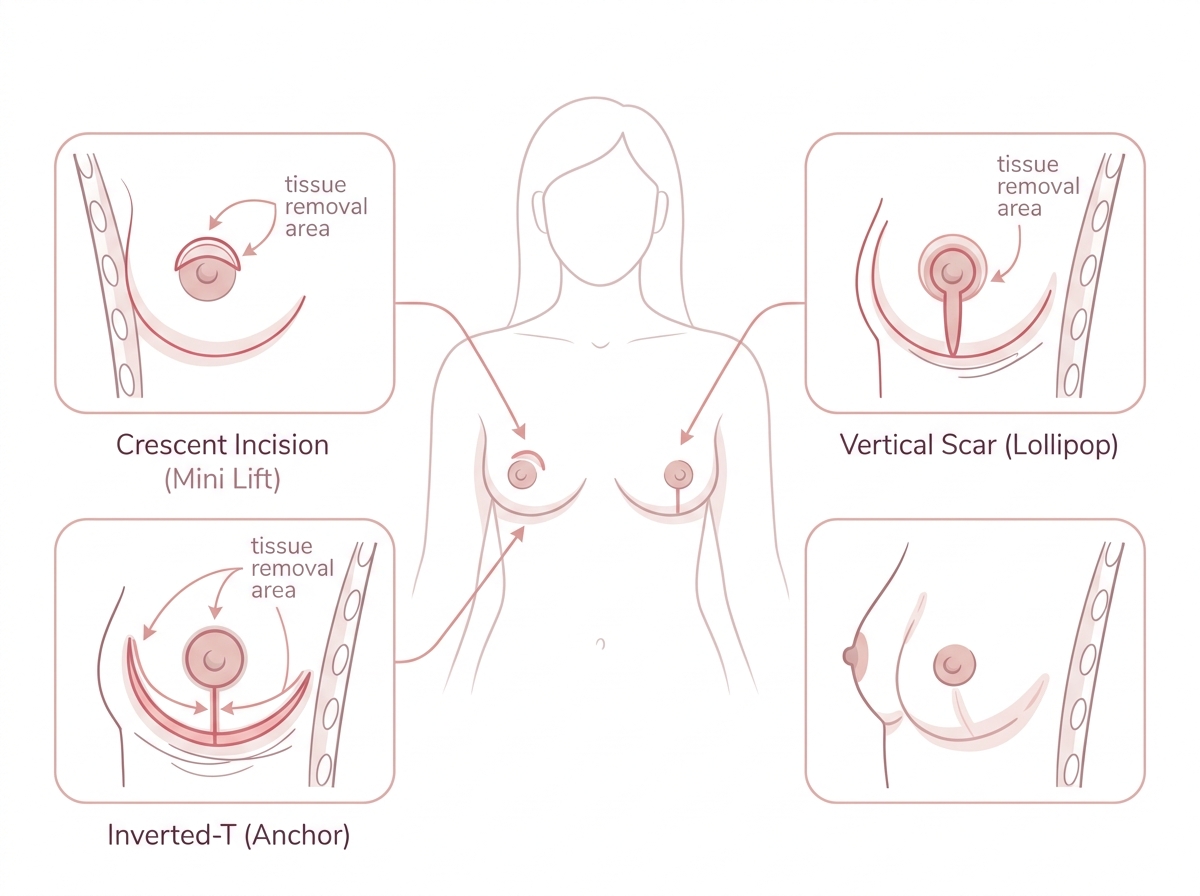
The extent of excess skin determines the incision. 3 standard patterns exist:
- Crescent incision: A small half-moon cut above the areola. Suitable only for Grade 1 ptosis with minimal skin excess. Rarely appropriate for post-GLP-1 changes.
- Lollipop (vertical) incision: A circle around the areola plus a vertical line from the areola to the IMF. Suitable for moderate ptosis (Grade 2). Produces a shorter scar than the anchor technique and is the preferred approach for many GLP-1 patients with preserved skin quality.
- Anchor (inverted-T) incision: A circle around the areola, a vertical line and a horizontal line along the IMF. Necessary for Grade 3 ptosis or when significant skin excess runs along the lower breast. Produces the most comprehensive lift and is the most commonly required incision in patients who have lost more than 25 kg.
Tissue reshaping
The glandular tissue beneath the skin is reshaped into a tighter, more projecting cone. In some techniques, glandular flaps are used to fill out the upper pole from within, reducing the need for an implant.
Nipple-areola complex elevation
The NAC is elevated to its new position on a pedicle of tissue that preserves its blood supply and nerve connections. It is not detached and reattached – it travels to its new position on a living tissue bridge, which is what preserves sensation in most patients.
Skin closure
Excess skin is removed and the incisions are closed in layers. Dissolving sutures are used internally and the outer skin layer is typically closed with fine sutures or surgical glue. A surgical bra is applied in theatre.
What I explain to patients is this: the surgery sets the clock, but it does not stop it. A mastopexy after weight loss can produce a result that lasts a decade or more – provided the patient’s weight remains stable, they avoid smoking and they do not go through a major subsequent pregnancy. When those conditions are met, the results are genuinely excellent. The women who are most satisfied are those who waited the full 12 months and arrived at surgery in the best possible baseline condition.
Mr Debashis Ghosh, Consultant Breast and Cosmetic Surgeon
7. What is recovery like after mastopexy?
Recovery from a mastopexy is broadly predictable, though individual healing rates vary. The following gives a realistic timeline based on an uncomplicated procedure.
First 48-72 hours
Most patients are discharged the same day or following an overnight stay. Swelling, bruising and moderate discomfort are normal and prescription analgesia manages pain. Patients should not drive and should have a responsible adult with them for the first 24 hours.
Week 1
Rest at home. Light walking encouraged to reduce the risk of blood clots. Avoid lifting, reaching above shoulder height or any activity that raises the heart rate significantly. The surgical bra must be worn continuously.
Weeks 2-3
Most patients feel significantly more comfortable by day 10. First wound review at 1-2 weeks. Light desk work can typically resume after 2 weeks, provided the role does not involve physical exertion. The bra is worn for 6 weeks in total.
Weeks 4-6
Gradual return to normal activity. Low-impact walking and light lower-body exercise can resume from week 4 in most patients. Upper body and chest exercise remains restricted until 6 weeks post-operatively.
3 months and beyond
Residual swelling continues to settle and scars begin to soften and fade. Scar management – typically silicone gel or silicone sheeting applied from 3 weeks post-operatively – significantly improves the final scar appearance. Final results are typically assessed at 12 months.
8. Risks and realistic expectations
Mastopexy is a common and well-established procedure, but it carries real surgical risks that every patient must understand before consenting. This section is not intended to alarm – it is required information and any surgeon who does not cover it thoroughly in consultation should give you pause.
Surgical risks
- Bleeding (haematoma): occurs in 1-3% of cases. May require a return to theatre to drain.
- Infection: treated with antibiotics in most cases. Wound infections occur in 2-4% of patients.
- Wound breakdown: more common in smokers, diabetics and patients with a BMI over 30. The vertical and horizontal junction points of the anchor scar are the most vulnerable areas.
- Poor or hypertrophic scarring: scars that thicken, widen or become raised. Risk is higher in patients with darker skin tones and those with a personal or family history of keloid scarring.
- Changes in nipple or skin sensation: temporary numbness or altered sensitivity is very common (up to 50% of patients). Permanent change affects a smaller proportion.
- Asymmetry: minor differences in position, shape or size are common and often acceptable. Significant asymmetry requiring revision is uncommon.
- Partial NAC loss: very rare, but theoretically possible if blood supply to the nipple pedicle is compromised. Risk is substantially higher in smokers.
- Anaesthetic risks: general anaesthetic carries small but real risks including allergic reaction, deep vein thrombosis and, in the context of GLP-1 use, aspiration risk from delayed gastric emptying.
Realistic expectations
A mastopexy will not produce a completely “natural” looking breast without scars. The trade-off is explicit: scars in exchange for shape, position and proportion. Most women consider this a worthwhile exchange. The scars are positioned within the bra line and are typically not visible in most swimwear.
Weight regain after surgery will affect the result – this is relevant for women who plan to restart GLP-1 injections after a break or who are considering these medications for the first time. A meaningful weight gain after mastopexy can re-stretch the skin and cause the breast to drop again.
Results from mastopexy are long-lasting but not permanent. Ageing, gravity and hormonal changes (particularly at menopause) continue to act on the breast over time. Most patients maintain a substantially improved position for 10 years or more when baseline conditions – stable weight, no smoking, no pregnancy – are maintained.
Frequently asked questions
How long after stopping Ozempic or Mounjaro should I wait before a breast lift?
Most surgeons apply a minimum of 6 months of documented weight stability before proceeding. 12 months is the standard I prefer, because it confirms the plateau is genuine and allows the skin to retract as much as it naturally will. Operating too soon risks a result that shifts as the body continues to change – requiring revision surgery that could have been avoided.
Will a breast lift make my breasts bigger?
A mastopexy alone doesn’t add volume – it reshapes and elevates existing tissue. Many women find their breasts appear fuller after surgery because tissue that was sitting below the breast fold is now in the correct anatomical position. If you want genuine volume increase alongside the lift, augmentation-mastopexy with implants or fat transfer should be discussed at consultation.
What is the difference between a breast lift and a breast uplift?
They are the same procedure – both terms describe mastopexy, the surgical reshaping, repositioning and skin-tightening operation that elevates the nipple-areola complex.
Can I have a breast lift on the NHS after weight loss injections?
NHS funding for mastopexy following GLP-1 weight loss is exceptionally rare and typically requires documented evidence of significant functional problems, such as recurrent skin infections beneath the breast fold or severe postural problems attributable to breast ptosis. The vast majority of patients in this category fund the procedure privately.
How much does a breast lift cost in London?
Mastopexy in London typically ranges from £7,000 to £9,000 for a lift alone. Augmentation-mastopexy with implants ranges from £9,000 to £14,000, depending on implant type and the complexity of the lift required. At Harley Street Breast Centre, Mr Ghosh provides all-inclusive quotes that cover surgeon fees, anaesthetist, hospital facility, compression garments, post-operative review appointments and 1 year of follow-up care.
Will I lose nipple sensation after a breast lift?
Temporary changes in nipple sensation are common and affect a significant minority of patients in the first 3-6 months. Most resolve completely as nerve endings recover. Permanent loss of sensation is uncommon and affects a small percentage of patients. The risk is higher when tissue has been significantly repositioned, as is sometimes the case with Grade 3 ptosis. Your surgeon will discuss this in detail at consultation.
Are breast lift scars permanent?
Scars from mastopexy are permanent, but they typically fade and flatten considerably over 12-18 months. They are placed to sit within the bra line and are generally not visible in most swimwear. Scar management, using silicone gel or silicone sheeting started from 3 weeks post-operatively, substantially improves the long-term appearance of the scars.
Can I breastfeed after a mastopexy?
Many women breastfeed successfully after mastopexy however, the procedure does involve working around milk ducts, which may reduce milk production in some patients. If you are planning future pregnancies, it is important to discuss this before proceeding with surgery. The timing and technique can sometimes be adjusted to better preserve ductal anatomy.
Does taking Ozempic or Mounjaro affect my anaesthetic risk?
GLP-1 medications slow gastric emptying, which increases the risk of regurgitation and aspiration under general anaesthetic. This is a genuine clinical concern that all GLP-1 patients must declare pre-operatively. Most anaesthetists require a cessation period of at least 1 week for daily formulations and 2 weeks or more for weekly injectables such as Ozempic or Mounjaro. Your pre-operative assessment will confirm the exact protocol.
How many cup sizes will I drop after losing weight on GLP-1 medication?
There is no single answer – breast volume change depends on your starting composition, total weight lost, rate of loss and genetic factors governing where your body stores fat. Some women lose 1 cup size and others lose 3 or 4. The degree of ptosis this produces also varies considerably. A clinical examination with a surgeon is the only reliable way to assess your anatomy and determine what surgery, if any, is appropriate.
Will a breast lift affect my mammogram results or breast cancer screening?
Mastopexy involves reshaping breast tissue rather than removing it and it does not typically interfere with mammogram interpretation, although the radiologist should be informed that you have had breast surgery. If you are in the NHS breast screening programme, you should continue attending as normal. For women with a higher risk profile, discuss the timing of any surgical procedure with your GP or breast surgeon.
Sources
British Association of Aesthetic Plastic Surgeons (BAAPS)
British Association of Plastic, Reconstructive and Aesthetic Surgeons (BAPRAS)
Medical Disclaimer
This article is for informational purposes only and does not constitute medical advice. If you have concerns about breast changes after weight loss, please consult a qualified medical professional.
About Mr Debashis Ghosh
Mr Debashis Ghosh is a Consultant Breast and Cosmetic Surgeon based at Harley Street Breast Centre, 146 Harley Street, London W1G 7LD. A Fellow of the Royal College of Surgeons (FRCS) and a member of both BAAPS and BAPRAS, Mr Ghosh specialises in aesthetic breast surgery, breast reconstruction and the surgical management of breast cancer. He sees patients on an NHS and private basis and is known for his direct, evidence-based approach to surgical planning and patient communication. To book a consultation, call +44 (0) 207 034 6534.
If breast lift after weight loss injections is affecting how you feel about your body, the next step is an assessment with a BAAPS and BAPRAS registered surgeon. Mr Debashis Ghosh, Consultant Breast and Cosmetic Surgeon at the Harley Street Breast Centre, 146 Harley Street, London, will examine you, grade the changes and set out which options are realistic for your anatomy.
Book Your Consultation With Mr Ghosh
If you have lost weight on GLP-1 medication and are concerned about changes to your breast shape, Mr Ghosh offers thorough clinical consultations at Harley Street Breast Centre. He will assess your anatomy, explain your surgical options clearly and provide an all-inclusive quote with no hidden costs. Consultations are available for both self-funding patients and those wishing to explore financing options.
Harley Street Breast Centre | 146 Harley Street, London W1G 7LD | Tel: +44 (0) 207 034 6534
Wondering what this means for you?
Start with a free telephone consultation from home, or meet Mr Ghosh in person on Harley Street. Ask anything, decide nothing until you are ready.
Book a Consultation